Unizon home

How it works

One subject, many lenses

A Unizon path picks one subject and comes at it from several directions. Each direction is a lens, and each lens is its own module. By the end you have seen the subject the way a mathematician, a scientist, a psychologist, a historian and a maker would, and you have made something with it.

The approach

  1. Pick a subject

    Each path is built around one subject. The first is Media, the stuff you watch, read, scroll and share every day. The Math of Hockey is the first lens of a Hockey Path.

  2. Look through each lens

    The Media Path has eight lenses: Math, Science, Psychology, Technology, History, Language & Storytelling, Art & Design and Execution (making it yourself). Work through them in order, or start with the lens that grabs you.

  3. Learn at your own pace

    Every module opens with a real question, lays out the First Principles, then works through short sections. Each section is marked so you know what's what:

    • Core: the main path, everyone does this part
    • Level Up: optional, harder challenges
    • Try It: hands-on experiments

    Each module ends with a Self-check, a Make it task, 5 Questions and a Side Quest.

  4. Make something real

    The last Media lens, Execution, is a production toolkit for planning, making, polishing and sharing your own media, plus the rules for consent, privacy, copyright and credit. It sets you up for the Capstone: one finished piece of media that uses all eight lenses.

On screen or on paper

Interactive online

Open any module in a browser. Type on the lines, tap the circles and meters, or switch on Draw to sketch with a finger, stylus or mouse. Your work is saved in that browser on that device only; nothing is sent anywhere. When you're done, print your work.

Printable

Every module prints straight from your browser on US Letter paper, so you can work with a pencil, or print your finished work. Printed copies of the modules and the full Media Path book are on the way.

Samples

Try a module

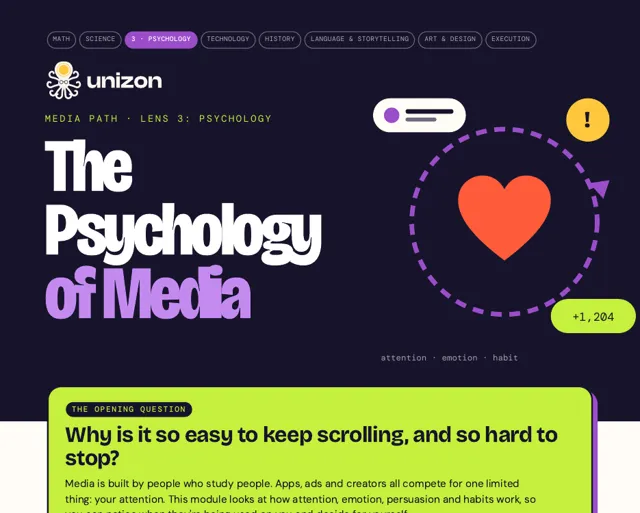
Cover of The Psychology of Media

Media Path · Lens 3: Psychology

The Psychology of Media

“Why is it so easy to keep scrolling, and so hard to stop?”

Media is built by people who study people. This module looks at how attention, emotion, persuasion and habits work, so you can notice when they're being used on you and decide for yourself.

  • Attention & hooks
  • Persuasion in ads
  • Emotion, outrage & sharing
  • The feed loop & healthy habits
  • Framing & cognitive bias
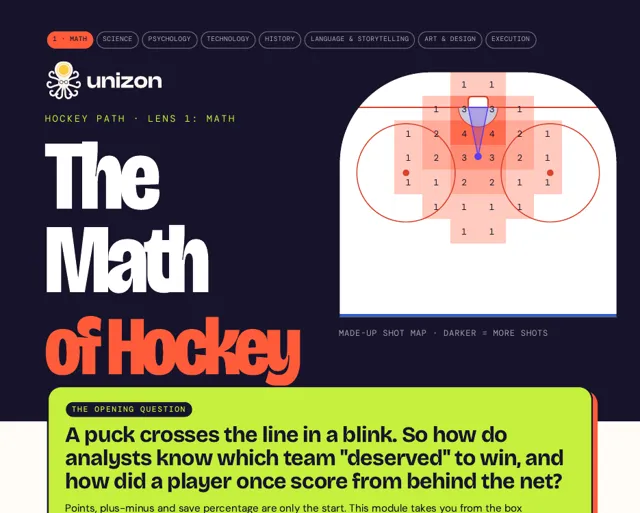
Cover of The Math of Hockey

Hockey Path · Lens 1: Math

The Math of Hockey

“A puck crosses the line in a blink. So how do analysts know which team “deserved” to win, and how did a player once score from behind the net?”

Points, plus-minus and save percentage are only the start. This module goes from the box score to shot attempts, expected goals and tracking data, then into the geometry of the rink and the physics of the “Michigan” goal.

  • Percentages & puck luck
  • Shot attempts: Corsi & Fenwick
  • Expected goals (xG)
  • Rink geometry & angles
  • The physics of the Michigan
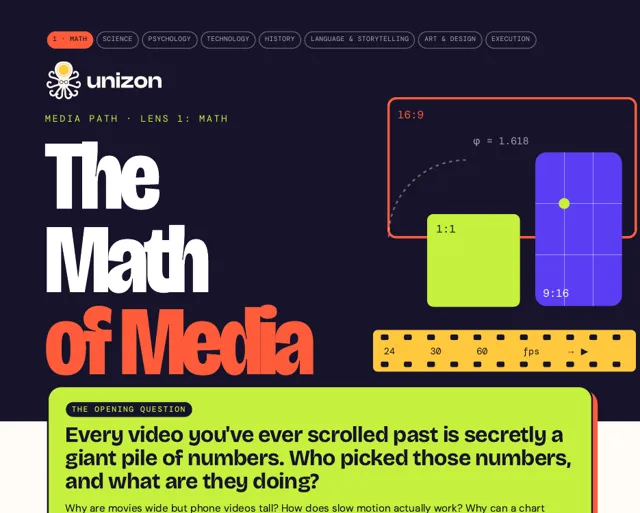
Cover of The Math of Media

Media Path · Lens 1: Math

The Math of Media

“Every video you've ever scrolled past is secretly a giant pile of numbers. Who picked those numbers, and what are they doing?”

Why are movies wide but phone videos tall? How does slow motion actually work? Why can a chart tell the truth and still lie? All you need is multiplication and division.